Arabic Holy Bible
Arabic Bible has got all chapter of all Testaments.
nSource Lab · by.nsource.prj_bible_arabic




UpdatedApr 7, 2026
PublishedFeb 16, 2021
Packageby.nsource.prj_bible_arabic
MD52697c694272fa50f482ebbcd25031bc7
SHA1 (signer)EA:52:1E:20:3F:6C:9F:28:66:33:6C:50:3C:1C:19:7A:D6:72:95:7D
Signed byCN=nSource Lab, O=nSource Lab, C=BY
Architecturesx86, x86-64, armeabi-v7a, arm64-v8a
Malware scanTRUSTED
Contact[email protected]
Privacy policyView
Description
Arabic Holy Bible has got all chapter of Old Testament and New Testament.
Translations of the Bible into Arabic are known from the early Christian churches in Syria, Egypt, Malta and Spain. Some of these translations are from Syriac (the Peshitta), Coptic or Latin. The earliest fragment of the Old Testament in Arabic is a text of Psalm 77, found in the Umayyad Mosque, dating from the 8th century. The first Jewish translations of the Hebrew Bible, and the bible translations by Roman Catholic clergy date from c. AD 1000. One of the oldest Arabic bibles was discovered in the 19th century at Saint Catherine's Monastery. The manuscript called Mt. Sinai Arabic Codex 151, was created in AD 867. It includes the biblical text, marginal comments, lectionary notes, and glosses, as found in the manuscript. Most Arabic translations have translated Yahweh (יהוה), the Hebrew name of God (LORD or Jehovah in English / Kyrios in Greek), as Allāh or Rabb (الله or رب, respectively). These are also the most frequent appellations made by Muslims as per Classical Arabic. The Aramaic Mār / Mōr (teacher or lord) is translated as Rabb or Sayyid (رب or سيِّد, respectively). There are many cases where an etymological root exists between an Arabic word and the original Hebrew or Aramaic text, yet it is translated into a colloquial or a commonly used word instead.
Benefits of application:
- The application works without an internet connection (offline);
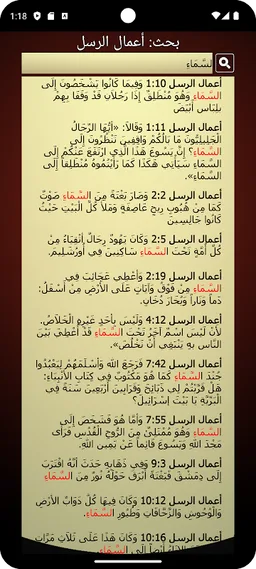
- Ability to search;
- Ability to increase / decrease the font;
- Ability to create an unlimited number of tabs to a particular verse, one of the books;
- If you are interested in the allocation of poems you can copy or send a message;
- Ability to scroll through the volume buttons.
Our team is not in place, and aims to expand its functional applications.
User guide:
Each menu item is a separate book, and each separate page in one of the books is the head.
Place the cursor instead of the chapter number and enter the chapter number. Thus, you will not have to scroll all the chapters, selecting interesting.
Translations of the Bible into Arabic are known from the early Christian churches in Syria, Egypt, Malta and Spain. Some of these translations are from Syriac (the Peshitta), Coptic or Latin. The earliest fragment of the Old Testament in Arabic is a text of Psalm 77, found in the Umayyad Mosque, dating from the 8th century. The first Jewish translations of the Hebrew Bible, and the bible translations by Roman Catholic clergy date from c. AD 1000. One of the oldest Arabic bibles was discovered in the 19th century at Saint Catherine's Monastery. The manuscript called Mt. Sinai Arabic Codex 151, was created in AD 867. It includes the biblical text, marginal comments, lectionary notes, and glosses, as found in the manuscript. Most Arabic translations have translated Yahweh (יהוה), the Hebrew name of God (LORD or Jehovah in English / Kyrios in Greek), as Allāh or Rabb (الله or رب, respectively). These are also the most frequent appellations made by Muslims as per Classical Arabic. The Aramaic Mār / Mōr (teacher or lord) is translated as Rabb or Sayyid (رب or سيِّد, respectively). There are many cases where an etymological root exists between an Arabic word and the original Hebrew or Aramaic text, yet it is translated into a colloquial or a commonly used word instead.
Benefits of application:
- The application works without an internet connection (offline);
- Ability to search;
- Ability to increase / decrease the font;
- Ability to create an unlimited number of tabs to a particular verse, one of the books;
- If you are interested in the allocation of poems you can copy or send a message;
- Ability to scroll through the volume buttons.
Our team is not in place, and aims to expand its functional applications.
User guide:
Each menu item is a separate book, and each separate page in one of the books is the head.
Place the cursor instead of the chapter number and enter the chapter number. Thus, you will not have to scroll all the chapters, selecting interesting.
Required features
- Faketouch android.hardware.faketouch
- Screen Landscape android.hardware.screen.landscape
- Screen Portrait android.hardware.screen.portrait
- Wifi android.hardware.wifi
Permissions (14)
Arabic Holy Bible requests the following Android permissions:
- Access Adservices Ad Id android.permission.ACCESS_ADSERVICES_AD_ID
- Access Adservices Attribution android.permission.ACCESS_ADSERVICES_ATTRIBUTION
- Access Adservices Topics android.permission.ACCESS_ADSERVICES_TOPICS
- Access Network State android.permission.ACCESS_NETWORK_STATE
- Access Wifi State android.permission.ACCESS_WIFI_STATE
- Foreground Service android.permission.FOREGROUND_SERVICE
- Internet android.permission.INTERNET
- Vibrate android.permission.VIBRATE
- Wake Lock android.permission.WAKE_LOCK
- By Nsource Prj Bible Arabic Dynamic Receiver Not Exported Permission by.nsource.prj_bible_arabic.DYNAMIC_RECEIVER_NOT_EXPORTED_PERMISSION
- Com Android Vending Billing com.android.vending.BILLING
- Com Android Vending Check License com.android.vending.CHECK_LICENSE
- Finsky Permission Bind Get Install Referrer Service com.google.android.finsky.permission.BIND_GET_INSTALL_REFERRER_SERVICE
- Gms Permission Ad Id com.google.android.gms.permission.AD_ID